 A total ban on in-season testing, major revisions to engine
regulations and dramatic cuts in aerodynamic development have formed
the cornerstone of a radical rules overhaul that will cut costs in
Formula One.
Following a meeting of the FIA’s World Motor Sport Council in Monaco
on Friday, the FIA announced a host of measures that have been agreed
with the Formula One Teams Association (FOTA) and will be put in place
over the next few years that will cut budgets by at least one third
from next year.
All in-season testing, apart from that conducted during scheduled practice on a grand prix weekend, has been banned.
Teams have also been outlawed from using any tunnel that exceeds 60
percent scale and 50 metres per second after January 1, 2009. Factories
will also have to be closed for six weeks per year.
Engine life is to be doubled, with drivers limited to a maximum of
eight power-units over the course of the season – plus four for
testing. However, the three-race rule voted through on November 5
remains in place.
This extra life will be achieved through a rev reduction to
18,000rpm, with no internal re-tuning allowed. Adjustment to trumpets
and injectors will only be allowed.
The reduction to 20 engines per team for the season means engine
budgets for independent teams should be cut in half compared to this
season.
Teams will also have their manpower reduced at race weekends through
a number of measures, including the sharing of information about tyres
and fuel that will eliminate the need for spotters.
The FIA is hoping that the above measure will ensure a big enough
cut in team budgets for next year. In a statement issued on Friday it
said: "It is estimated that these changes for 2009 will save the
manufacturer teams approximately 30% of their budgets compared to 2008,
while the savings for independent teams will be even greater."
For 2010, the regulation changes get even more dramatic.
The door has been left open on the FIA’s offer of a standard
specification engine, with it being made clear engines will be made
available to independent teams for 5 million Euros per season.
This will either come from an independent supplier like Cosworth,
who won the FIA’s tender for a standard engine, or from manufacturer
teams providing they give guarantees. These engine specifications will
also be used in 2011 and 2012 as well.
It is hoped that a standard transmission can be used, and work will
be conducted on using as many standard parts on a chassis as possible –
where teams agree that these bits should not be performance
differentiators.
On race weekends there will be standardised radio and telemetry
systems, a ban on tyre warmers, a ban on the mechanical purging or
tyres and a ban on refuelling. This will come alongside further
restrictions on aerodynamic research and other possible limits on
factory facilities.
The FIA is also to conduct a market research programme to work out
whether there should be changes to qualifying, the use of a medal
system instead of points or a reduction in race distances.
There is also the possibility of a standard KERS being used in 2010,
but this depends on a proposal being put forward by FOTA. A number of
teams may decide not to run the devices next year amid fears about
mounting costs.
Regarding the longer term future, the FIA statement added: "The FIA
and FOTA will study the possibility of an entirely new power train for
2013 based on energy efficiency (obtaining more work from less energy
consumed). Rules to be framed so as to ensure that research and
development of such a power train would make a real contribution to
energy-efficient road transport."
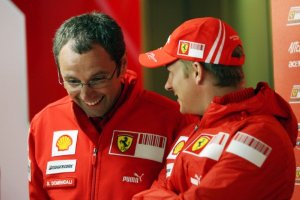
 This is important news, which will probably change our experience of being fans of the sport because these drastic changes mean that the racing itself and the way the drivers work, like Kimi, will be affected. I do not agree with some of the rules especially for 2010 (read the full list of measures) but it’s the same for everybody. A ban on in-season testing is a bit harsh, as developement is the heart of the competition during the season and it doesn’t really give chance to teams who aren’t competitive enough at the start. It’s going to be tough to work by, especially for the smaller teams. It’s saving them a lot obviously, but in a way it will still be difficult for them to compete with the top teams.
For Ferrari, with Domenicali replacing Todt after 2007, there might be a little ‘scare’ as he’s still gelling into his new role and all the pressures and responsibilities, but I’m sure Domenicali and the team will be fine, as he proved this year by winning the constructors and he’ll receive the award for that tonight in Monaco, where Hamilton will claim his world championship trophy. It’s a whole new story for the teams now with these changes, and it’ll be big fight all over again next season and it’ll be more intense between McLaren and Ferrari. Kimi is committed enough to help Ferrari get through this new stage in history and the team feel will the same. In a recent interview, Domenicali stated: "He (Kimi) should know that behind him and together with him there’s a team that’s capable of exalting his talent, which, believe me, is unique in the world.”
That’s a very special statement, because through changes like these it’s the relationships between the drivers and their teams which need to be very strong and full of understanding. These radical cost-cutting rules aren’t just about cost-cutting, everyone’s affected in different ways.
I wonder if there will be some sour faces at the FIA Gala tonight! (Follow it in the KRS Forum) Hopefully, we’ll see more of what’s going on in this picture with Domenicali and his boys.
 Kimi Räikkönen Space